
TL;DR Played a session in this dungeon while dressed up as wizards. We had a great time but I wish the module was better.

It's a strange Halloween year. Tuesday is an awkward day for the holiday, so people have been intermittently partying all weekend. I've avoided most of it, but the party happily came to me in Friday. Our good friends Nick and Michelle came over after dinner with wizard costumes, but no party to go to. Jah and I put on what we had, Medusa and random Renaissance Faire stuff respectively, and there we were, eating and drinking cocktails. How about a game?
 Nick was intrigued by my copy of Forbidden Caverns of Archaia sitting on the coffee table. It's Fall colors appealed. "Let's play that!"
AN UNCOMMON EVENING
We whipped up characters for my "Uncommon Dungeons" ruleset. It was quick and easy. My wife and our friends have mostly played type V D&D, but they soon got into rolling 3d6 for the stats, writing the minimal information on a blank paper and getting down to business. I was pretty happy with the speed and ease of it. The longest time was spent writing down gear. I had no time to prepare so I got right to it. "You have been trekking through the badlands all day, through sand storms and scorching heat, buzzards circle overhead as you pass macabre crucifixions in wastes. Finally you arrive. You see this." I held up the illustration.
An overly fanatical Dwarven Cleric, a crafty Elf Wizard, and a brave Fighter descended the rocky trail to canyon floor. I said, "Now you see THIS," again I held up a picture in the book.
Player rolls on the Doom Die forced the group to hunker down and eat their rations. While they did that, a tremor rumbled through the canyon. The walls shook and one nearby cliff partially collapsed. They group rushed into the nearest cave they could find, for shelter.
 Within, an ominous silence. Torchlight revealed a long hall, pockmarked with holes and splattered with dried blood. The sharp eyed elf spied a secret door on the right so the dwarf barged in a promptly fell through a trap door! A Pfaetherfall spell saved him but he happily took a proffered rope back up as he found himself in a barred cell with a skeletal inmate and a jailor coming to investigate.
The trio fled that cave and ran across to an ancient arch with a skull shaped keystone. Carefully tapping their way down a long stairs, the three began to explore what was certainly an ancient Archaian building. They found an old scroll still sealed in its stone tube. A rigged crossbow trap shaved a whisker off the dwarfs beard.
 Then a sudden tremor shook the complex violently. Stone and dust rained down, the earth lurched and suddenly a gaping crevasse opened across the trio's retreat. Then came the zombies. They came through a crack that had been opened in a wall. The wizard stepped forward and poured fire upon them all but it wasn't enough. Still they advanced. The fighter hacked with her axe. The cleric healed then tried to heal again. He remembered this morning's augury. "Woe". The dwarf died at the hands of his own hubris.
A the last zombie fell, and the fighter realized she was on her own for the wizard had succumbed to her own magics as well. The fighter loaded the frail elf on one shoulder and ran out of there. She didn't stop until she got back to Eastdale.
The Forbidden Caverns were gamed. Totally spontaneously. They claimed their first PC. We had a great time. In wizard costumes. The players did more drama troupe acting and funny voices than I did this session.
REVIEW OF THE FORBIDDEN CAVERNS OF ARCHAIA
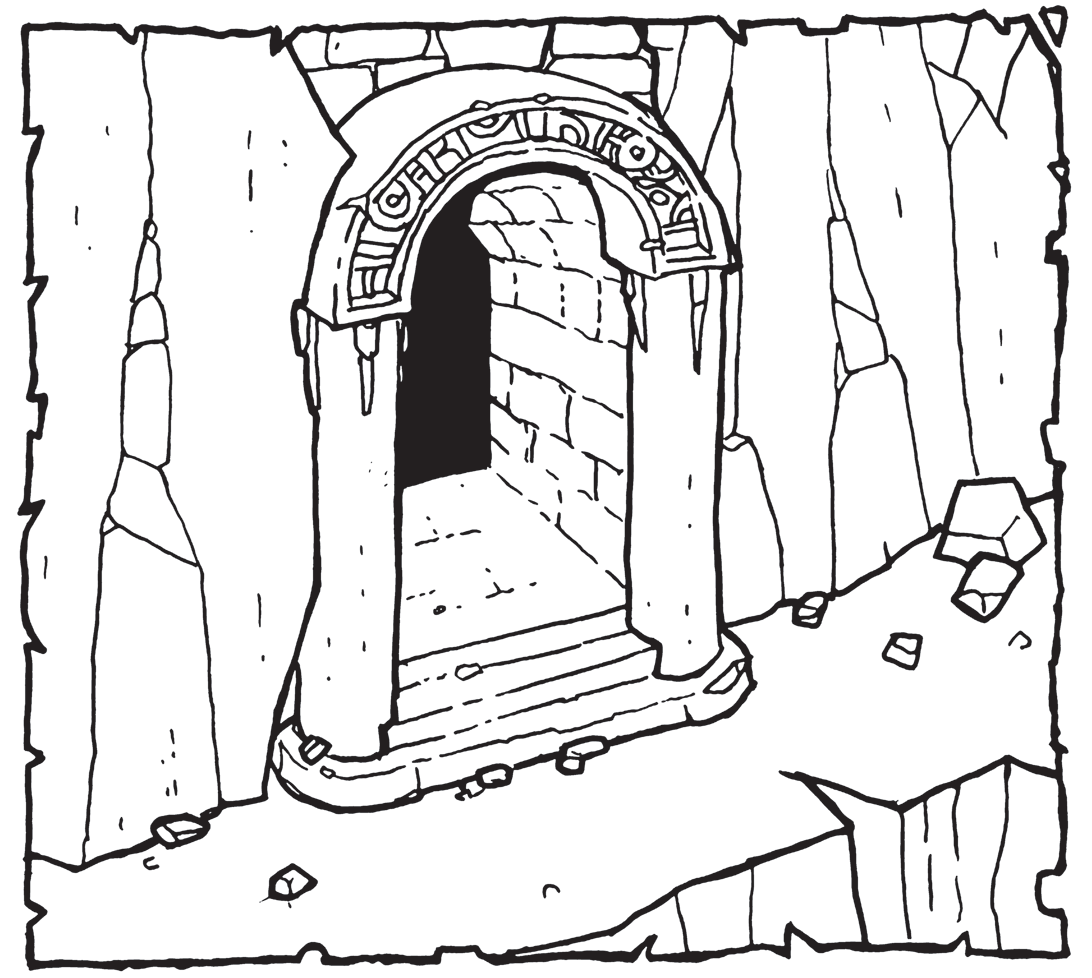 I have to admit I've been fairly ambivalent about the Forbidden Caverns. I'd been looking forward to it for about a year as I have been steadily playing the Barrowmaze Complete book I bought as part of the same kickstarter. I was stoked when I finally got my copy in the mail, started doodling in it but lost interest kinda quick. I've gotten more playtime out of BMC than most game books in my collection. The classic simplicity of it works well. This is all well and good. I really like the aesthetic of the book. Stefan Poag and Peter Pagano do a lot of really great work that really makes the whole things look really cool. I don't love the cover. Erol Otus is awesome but the covers for these two books are not that rad. Maybe too cartoony, not mysterious enough.
  The Forbidden Caverns are more of the same after Barrowmaze. That's part of the problem. The set up doubles down generic/classic depending on your perspective. There is a canyon full of ruins and caves inhabited by every type of evil humanoid monster: goblinoids, beastmen, lizardmen, evil humans, even giants. They are all part of an army that will one day pour forth to devastate the world. In the meantime they are collecting trash and living in a very geologically active area. There are dozens of small to medium to huge dungeons in the book, Unfortunately the dungeons themselves are pretty straightforward. Here's this kind of monster. Now here's this other one. I have had to really look through the book carefully a couple of times to start to figure out which questions to ask to make this dungeon interesting. How is it any different than Barrowmaze (or even Caves of Chaos)?
It actually suffers from some of the same problems as Barrowmaze in that it is unclear what anyone is doing there. In Barrowmaze most things are undead, so they're obviously just hanging around zombie-ing out, but then you occasionally run into Necromancers of Orcus or Set or Nergal and there is no personality to any of them, no sense of in what way the three factions are different (skull face, pentagram head, uh) or really what they want in the maze. The campaign setting is super similar as well. The town of Eastdale is basically just a re-skinned Helix with some mention of how the local paladins are teetotalers so carousing is frowned up. Now there's the mission!
 Forbidden Caverns is similar. There are all these monsters and hideouts and lairs, and a bunch of them have these Chaos Priests/Warriors of Impurax lurking in the back rooms but there's no sense of what their doing and why. The Chaos dudes get names but no sense of who they are our how the wrangling of their particular group of evil humanoids is going. Deep in the final dungeon are the High Priestess of Impurax and also a couple of old magical liche type creatures. How do they relate each other? I'm going to need to use one of those old npc relationship tables from Vornhiem to make it interesting.
It all seems very static, but unlike Barrowmaze, the Forbidden Caverns are the opposite of static. There are constant earthquakes and collapses (I decided that anytime a Doom Die roll repeated itself that would signal a quake), there is a growing garbage mound, there are violent evil monster armies full of factions who don't like each other. This sandbox needs to be dynamic.
The DM needs to do a bit more prep. Basically, every dungeon resident needs to have a grudge against or alliance with another (Froglings plotting to take out the Kobolds for example). Especially the Chaos warriors. They have names, so we need to make a table add some random stuff and give those guys problems with each other, goals, attitudes toward the beastmen and orcs they are supposed to by wrangling. The archons at the end need it as well. Just a couple of "wants" and "needs" phrases for these guys would really help the whole thing. The only reason for all these different monsters to be hanging to together is because this great prophecy of Impurax that must say something about how it will require "ever finger of the hand of Chaos to bring the dark god to this realm." That has to be the thing, and that needs to become player character knowledge pretty early on in a campaign but that sort of hint and clue is left entirely up to the DM. At the very least all the Impurax guys should be carrying around the Rotting Hand diagram.
I don't mean to bag on the book too much. I just had a great session with it. I obviously have been thinking about how to run it. I love the art. The "wheel of time" is great. There are some cool magic items, especially the modular staff items that can be put together in different combinations to unlock different abilities and different magic gates. It is totally playable from cracking the book and I love the illustration section. I love BMC's illustration section. I always dig the illo sections of Goodman Games modules as well. All modules should have dedicated illustration sections.
All in all, I'm going to stick this dungeon in my campaign world somewhere, but it doesn't make me want to lure my players out of the Barrowmaze to explore the Caverns. Might happen at some point though.
 |
| This diagram needs to be found in the possession of the Horde bosses and Fanged Legion reps, because how else are they gonna keep it all straight? |


